
Free tool · No sign-up required
Hourly Rate Calculator
Calculate the customer rate you need to cover costs, pay yourself, and earn a profit — from your real billable hours, not your hopeful ones.
Everything stays in your browser — nothing you enter is sent to or stored on our servers.
Pricing a whole job? Use the service price calculator, or get Revenuor for iPhone & iPad.
Start from an example setup:
Example inputs are for demonstration. Use your own compensation goals, costs, and billable hours.
Recommended customer rate (before tax)
No billable hours yet — increase available hours or utilization to calculate a rate.
- Break-even rate
- Annual billable hours
- Annual cost base
- Annual revenue target
- Annual profit
- Margin / markup
Where the hours go (per worker)
- Nominal working hours
- Paid time off
- Available working hours
- Non-billable but paid
Annual cost base
- Payroll / self-employment burden
- Benefits / retirement
- Owner / manager compensation
- Overhead (incl. callback allowance)
- Annual cost base
What should I charge for a short job?
At your recommended rate, with your minimum in mind. The service call fee calculator prices the visit itself — travel, diagnostics, and call-out policies.
- Recommended job charge
- Effective rate incl. unbilled time
Your minimum charge is setting this job's price.
How this rate is calculated
- • Break-even rate = cost base ÷ billable hours
Editable example assumptions — not market rates or tax advice. Want to price by markup instead? The service price calculator supports both.
Put this hourly rate to work
Save an hourly service at this rate in Revenuor and reuse it in every estimate and invoice — alongside flat, per-item, and square-foot pricing. Or put it on a PDF now with the free estimate generator — and after the job, see what it really earned with the job profit calculator.
Download on the App StoreHow to calculate an hourly rate that actually works
Wage, labor cost, and customer rate are three different numbers
A $25 wage costs the business $28–30 once payroll burden lands, and the customer rate must be higher still — it carries non-billable time, overhead, and profit. Businesses that bill near the wage aren't cheap; they're subsidizing every job.
Billable utilization is the number everyone overestimates
Being at work 40 hours doesn't mean invoicing 40 hours. Driving between jobs, quoting, supply runs, callbacks, and bookkeeping are real hours no customer pays for directly. At 75% utilization, a 40-hour week yields 30 billable hours — and every billable hour must carry a share of the other 10.
Your pay is a cost. Profit is separate.
Decide what the business should pay you, put it in the cost base like rent or insurance, and only then add profit. If "whatever's left over" is your pay, you'll never see whether the business itself is actually profitable — or quietly failing.
Overhead divided by billable hours, not by wishful thinking
The truck, insurance, tools, software, marketing, accounting, and a callback allowance are annual facts. Divide them across the billable hours you'll really work — that's the piece of every hour that isn't wages and isn't profit, and skipping it is the most common way rates end up too low.
Break-even first, then margin
Cost base ÷ billable hours = break-even: the rate at which you survive but earn nothing as a business. Price above it deliberately. As with all pricing, margin and markup differ — a $100 cost with 25% markup is a $125 price at a 20% margin, while a 25% margin needs $133.33. This calculator prices by margin and always shows both actuals. And the profit margin calculator converts margin and markup instantly.
Hourly rates power flat prices and minimums
Even if you quote flat, the rate is the engine underneath: a two-hour job at your recommended rate, plus a minimum that covers showing up. Short jobs with unbilled travel are exactly where a weak rate bleeds — check the service-call box above with your own numbers. And the break-even calculator shows how many jobs that margin needs to cover your fixed costs.
A note on taxes
Labor is taxable in some places and not in others, and self-employment tax treatment varies. The calculator's burden fields are estimates for pricing, not tax advice — check your situation with a tax professional.
The same math, whatever your trade
Different overhead, different utilization — very different rates.
Solo operator
One person, one truck: pay target + burden + overhead across your own billable hours. The default example on this page.
Two-person cleaning team
Wages on all paid hours, billing only on billable ones — plus your own compensation carried as overhead if you don't clean.
Handyman
High travel between short jobs drags utilization down — which pushes the rate and the service-call minimum up.
Painter
Long jobs raise utilization; materials live in the job quote while the rate carries the business.
Lawn-care operator
Route-dense weeks push utilization up, but equipment-heavy overhead pushes the rate back up too.
Mobile detailer
The driveway is the shop: vehicle and product overhead on modest billable hours makes the honest rate surprise people.
Work out the rate once. Bill it on every job.
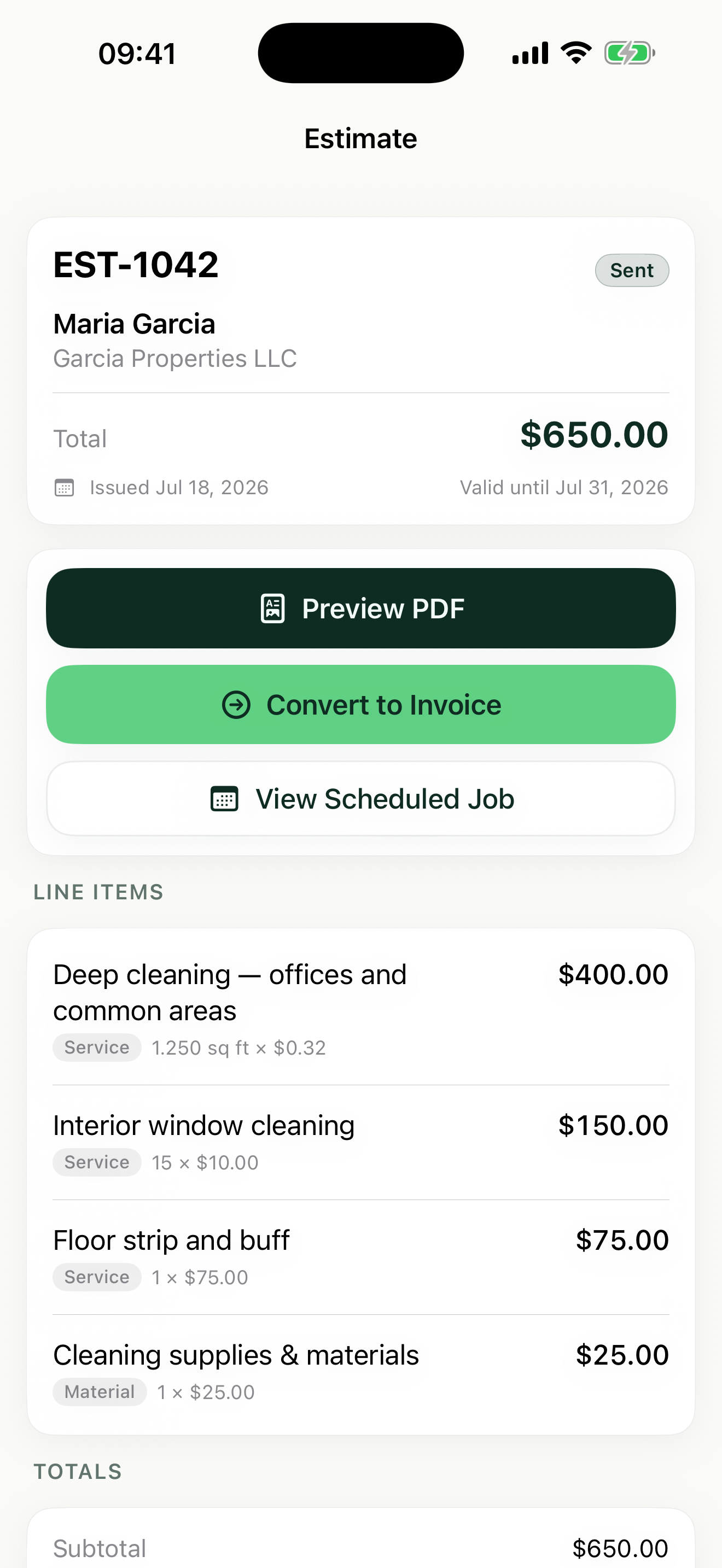
Save an hourly service at your rate in Revenuor — then every estimate, scheduled job, and invoice uses it in a few taps on your iPhone or iPad.
- Save hourly services and rates
- Mix hourly, flat, each, and sq ft pricing
- Professional estimate PDFs
- Schedule the job
- Invoice when the work is done
- Track unpaid invoices
Frequently asked questions
Is the hourly rate calculator free?
Yes. The calculator is completely free, with no sign-up and no limit on how often you use it.
Is my data stored?
No. Everything you enter — pay goals, costs, hours — stays in your browser. Nothing is sent to or stored on our servers, and the numbers are gone when you leave the page.
What is the difference between wage and billable rate?
A wage is what a worker is paid per hour. The billable rate is what the customer pays — and it must also cover payroll burden, non-billable time, overhead, and profit. Confusing the two is the fastest way to lose money by the hour.
How do I calculate billable hours?
Start from your working calendar (weeks × days × hours), subtract paid time off, then multiply by your billable utilization — the share of working time customers actually pay for. The calculator shows every step.
What is billable utilization?
The percentage of available working hours you can invoice. Driving, quoting, admin, supply runs, callbacks, and bookkeeping all consume paid time that no customer pays for directly. Most solo operators land well below 100%.
Should owner pay be included before profit?
Yes. Your target compensation is a cost the business must cover, like rent or insurance. Profit is what the business earns on top of paying you. Treating your own pay as "the profit" hides whether the business itself works.
How do I include payroll burden?
Add a percentage on top of wages for payroll taxes, workers' comp, and insurance — commonly in the 10–20% range depending on your location and setup. For owners, a self-employment burden estimate plays the same role.
How should I include overhead?
Total your annual business costs — vehicle, insurance, tools, software, marketing, licenses, accounting, and a callback allowance — and let your billable hours carry them. Overhead that isn't in the rate comes out of your pay.
What profit margin should I use?
There is no universal number — it depends on your trade, market, and risk. Many solo service businesses target somewhere between 10% and 30% on top of full costs including their own pay. Your goals should drive the choice.
Should I charge hourly or flat rate?
Customers often prefer flat prices, but every good flat price is built on an hourly rate underneath. Work out the rate here, then use it inside flat quotes with our service price calculator or the trade calculators.
How do I set a minimum service charge?
Cover what a visit costs before the work starts — travel, setup, and a base amount of profit. The service-call section on this page shows what a short job should cost at your rate and how unbilled travel drags your effective rate down.
Should sales tax be added to an hourly rate?
Labor is taxable in some places and not in others. The calculator shows your pre-tax rate and a tax-inclusive customer rate separately — check your local rules with a tax professional.
Can I save this rate in Revenuor?
Yes. Save an hourly service with this rate in the Revenuor app for iPhone and iPad, and reuse it in every estimate and invoice — alongside flat, per-item, and square-foot pricing.
Can I use this for employees and teams?
Yes. Switch to team mode: enter each billable worker's wage, burden, and benefits, keep your own compensation as overhead if you don't bill your time, and the calculator prices the team's billable hour.