
Free tool · No sign-up required
Profit Margin & Markup Calculator
Calculate selling price, profit, margin, and markup without mixing them up — solve from whichever numbers you know.
Everything stays in your browser — nothing you enter is sent to or stored on our servers.
Building the full price? Use the service price calculator, or get Revenuor for iPhone & iPad.
Start from an example:
Examples are for demonstration. Use your actual costs and pricing targets.
Your minimum charge is setting the final price.
Calculated price: · Minimum charge: · Final price:
- Cost
- Selling price (pre-tax)
- Profit
- Margin / markup
- Customer total
Use this margin in your next estimate
Build the full price with the service price calculator, check what your hour must earn with the hourly rate calculator — then save the service in Revenuor and reuse it in every estimate and invoice.
Download on the App StoreMargin vs. markup — the mix-up that costs money
Margin
Profit as a percentage of the selling price. A 25% margin means a quarter of what the customer pays is yours after costs.
Markup
Profit as a percentage of cost. A 25% markup means you take your cost and add a quarter of it.
$100 cost · 25% markup
- Selling price
- $125.00
- Profit
- $25.00
- Margin
- 20%
$100 cost · 25% margin
- Selling price
- $133.33
- Profit
- $33.33
- Markup
- 33.33%
| Margin | Equivalent markup |
|---|---|
| 10% | 11.11% |
| 15% | 17.65% |
| 20% | 25% |
| 25% | 33.33% |
| 30% | 42.86% |
| 35% | 53.85% |
| 40% | 66.67% |
| 50% | 100% |
These are mathematical conversions, not recommended margins — the right target depends on your trade, market, and true costs.
The same math in real pricing
Service job
Total the job cost — labor, materials, overhead share — then divide by (1 − margin). Pricing from cost is the whole game.
Material-heavy job
Big material bills make markup thinking risky: 25% markup on $1,000 of materials is only a 20% margin on that money.
Hourly service
Your billable rate already contains a margin — the hourly rate calculator builds it in from your pay target and overhead.
Flat-rate job
Customers see one number, but the margin underneath decides whether the flat rate works. Check it before quoting.
Small job with a minimum
When the minimum charge sets the price, your actual margin on that job is higher than target — that's the minimum doing its job.
After the job
Actual margin only means something computed from true costs — the job profit calculator does that with real hours and fees.
Related: the job profit calculator measures actual margin after the work, and the hourly rate calculator builds margin into your rate. And the break-even calculator shows how many jobs that margin needs to cover your fixed costs.
Set the margin once. Price every job with it.
Save your services with their rates in Revenuor — flat, hourly, per-item, or square-foot — and the margin you chose here travels into every estimate and invoice, from your iPhone or iPad.
- Flat, hourly, each, sq ft, or custom units
- Save reusable services
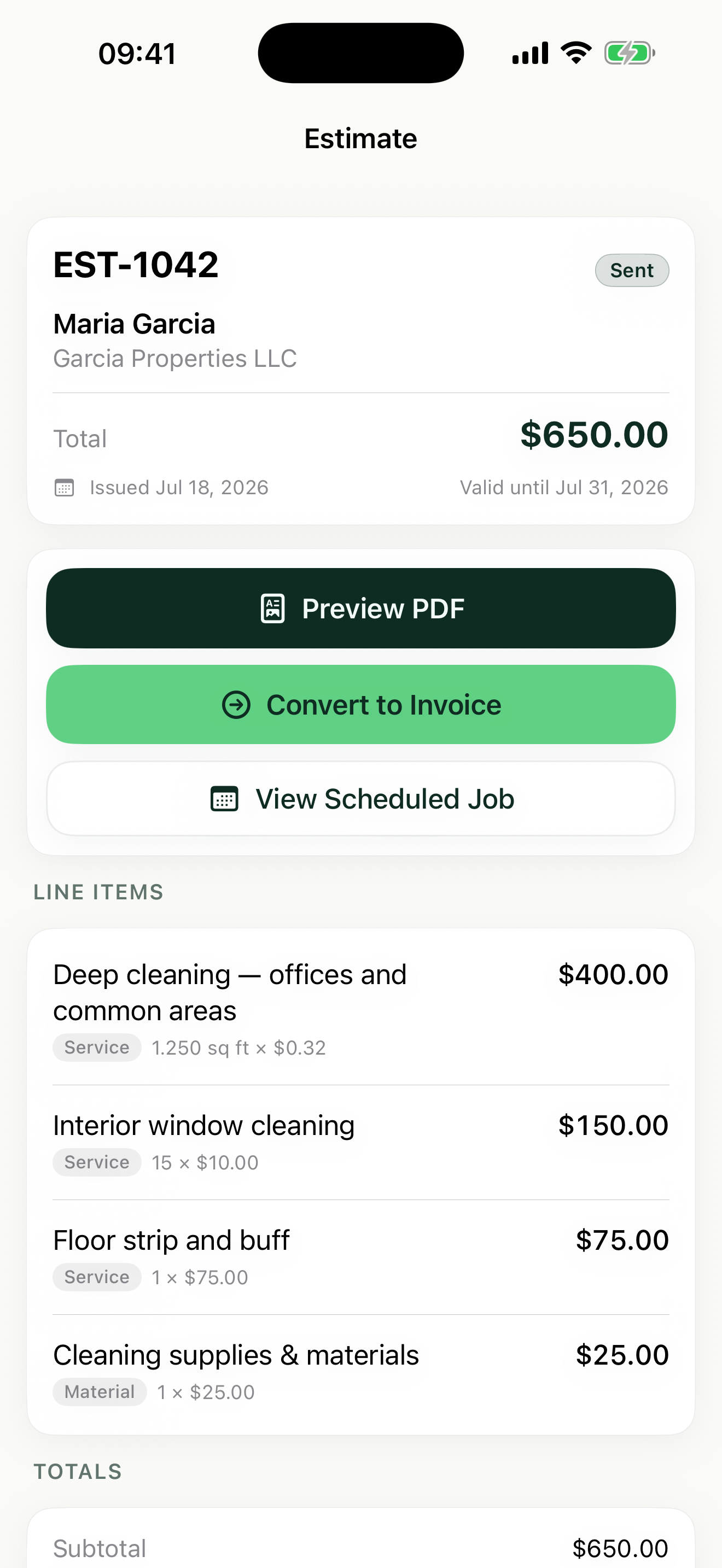
- Professional estimate PDFs
- Schedule the job
- Create the invoice
- Track payment
Frequently asked questions
Is the profit margin calculator free?
Yes. The calculator is completely free, with no sign-up and no limit on how often you use it.
Is my data stored?
No. Everything you enter stays in your browser. Nothing is sent to or stored on our servers, and the numbers are gone when you leave the page.
What is profit margin?
Profit as a percentage of the selling price. A $25 profit on a $125 selling price is a 20% margin — one fifth of what the customer pays is yours after costs.
What is markup?
Profit as a percentage of cost. The same $25 profit on a $100 cost is a 25% markup — you took the cost and added a quarter of it.
What is the difference between margin and markup?
They divide the same profit by different bases: margin by price, markup by cost. A 25% markup is only a 20% margin, and a 25% margin needs a 33.33% markup. Businesses that "add 25%" often earn less than they think.
How do I calculate selling price from margin?
Divide cost by (1 − margin). A $100 cost at a 25% target margin is $100 ÷ 0.75 = $133.33 — not $125, which is what a 25% markup gives you.
How do I convert margin to markup?
Markup = margin ÷ (1 − margin). So 20% margin → 25% markup, 25% → 33.33%, 50% → 100%. The conversion table on this page covers the common values.
Can profit margin be negative?
Yes. If cost exceeds the selling price, profit is negative and so is the margin — the job is priced at a loss. The calculator shows the loss plainly instead of hiding it.
Should sales tax be included in profit?
No. Collected sales tax passes through to the tax authority. This calculator computes margin and profit on the pre-tax selling price and shows the tax-inclusive customer total separately.
How should minimum charges affect margin?
When your minimum charge raises a small job's price above the margin-based calculation, your actual margin on that job rises too. The calculator shows both the calculated price and the actual margin at the minimum.
What margin should I use?
There is no universal number — it depends on your trade, market, overhead, and how completely your costs are counted. What matters most is computing margin from true costs; our job profit calculator helps with that.
Can I use this for service businesses?
Yes — the math is the same whether the cost is materials, labor, or a full job cost. For building the cost side itself, use the service price calculator or the trade calculators.
Can I use the result in Revenuor?
Yes. Price your services with this margin, save them in the Revenuor app for iPhone and iPad with flat, hourly, per-item, or square-foot rates, and reuse them in every estimate and invoice.